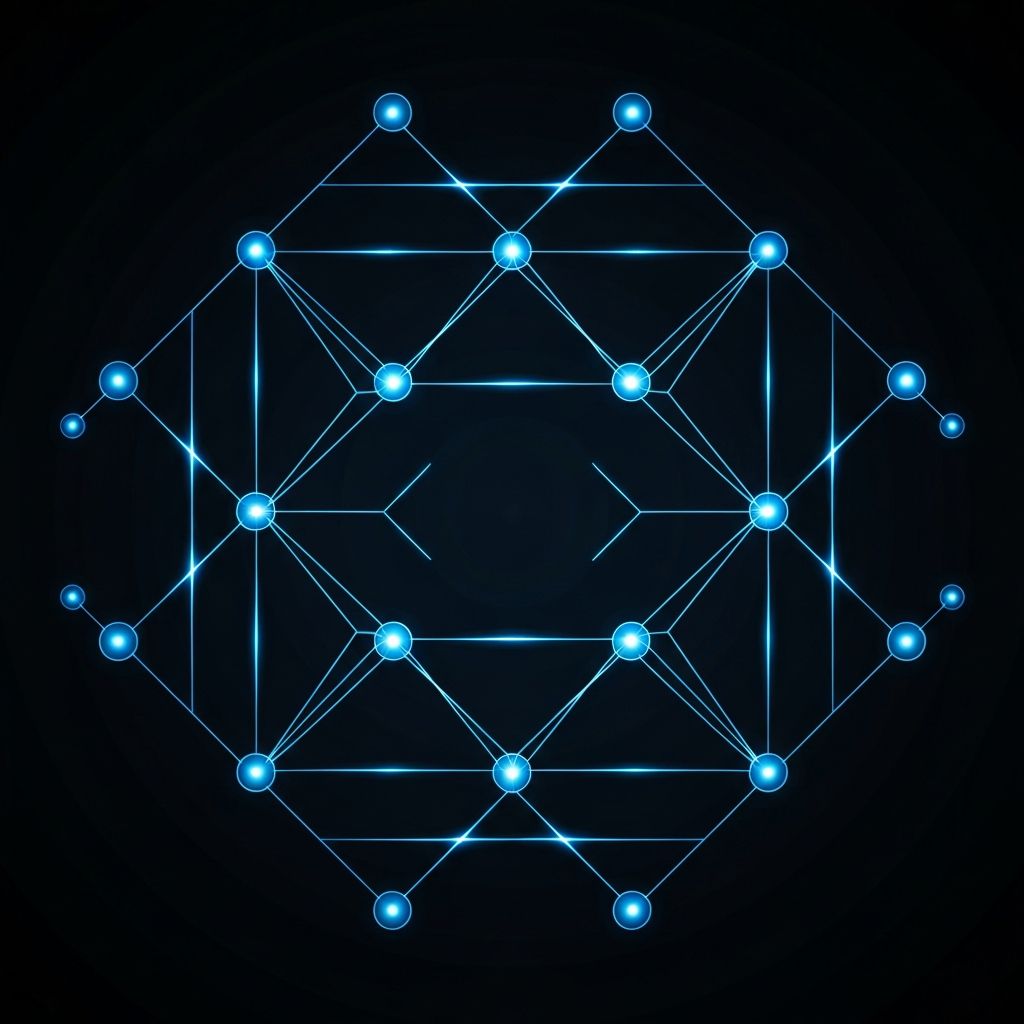
The Cauldron: Building a 10-State Quantum Universe
How D8 × Z2 symmetry creates a minimal exactly-solvable quantum system.
The Cauldron is our implementation of a 10-state quantum system based on D8 × Z2 symmetry. Unlike traditional quantum computing approaches that scale up qubits, we're exploring what becomes possible when you work with a carefully structured, finite state space.
The architecture is straightforward: imagine an octagon where each vertex represents a quantum state (states 2-9). At the center sits a binary qubit (states 0 and 1). The total 10-state system has exactly 45 possible transitions, but not all are created equal.
The key insight is the 'δ-pair' structure. Each state on the ring has a complementary partner directly across from it: 2↔6, 3↔7, 4↔8, 5↔9. These pairs have special properties - transitions between δ-pairs preserve certain quantum coherence properties that other transitions don't.
We order these pairs using what we call the 'quadratic moment functional': I = a² + b² where a and b are coordinates in the ring. This gives us the canonical ordering: (1,1), (1,2), (2,2), (1,3), (2,3), (3,3)... Each pair maps to a specific physical meaning in applications.
For the Battery Management System (BMS) application, these states translate directly to MOSFET configurations: which gates are open, which are closed, and how current flows through the system. State 0 is full shutdown, State 1 is standby, and States 2-9 represent various charging/discharging configurations.
The beautiful part is that the symmetry constraints guarantee certain safety properties automatically. You can't transition from a high-power charging state directly to a fault state - the symmetry forces you through intermediate states that provide natural current limiting.
We've implemented this in Arduino/ESP32 firmware (available in our GitHub) and are currently testing with real lithium cells. Early results show the δ-transition constraints preventing several failure modes that would require explicit safety code in traditional BMS architectures.
The Cauldron isn't just theory - it's running on real hardware, managing real batteries. And the same mathematical structure can be applied to blockchain consensus, state machines, and anywhere you need guaranteed state transition properties.